One of the most visited visited aquariums in France
A quality approach
The Océarium du Croisic is committed to a quality approach that includes almost 200 criteria. The aim of the approach is to :
Ensure you receive a warm welcome
Ensure our staff are attentive to your needs
Offer assistance in foreign languages
Offer personalized services and provide clear and accurate information
Guarantee comfort and cleanliness
Take into account the opinion of our customers
From the Sea to the Aquarium
2,500 cubic metres of natural seawater: this is the total volume held by the aquarium’s installations.
This vital element for any aquatic organism is pumped up 400 metres from where the Océarium stands.
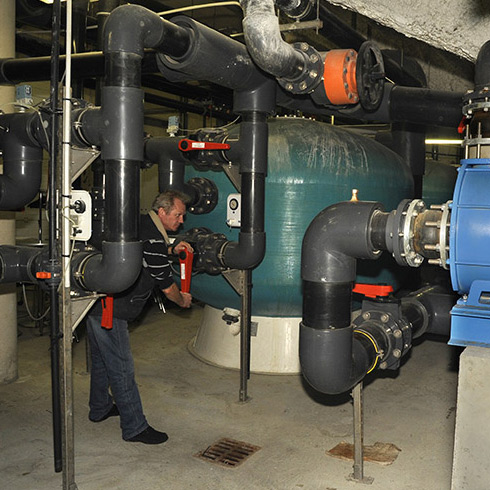
First the water is stored, then decanted into two tanks measuring 200 cubic metres. It is then filtered, using two techniques:
mechanical filtration
sand filtration of the type used by swimming pools.
The seawater is regularly monitored. The main parameters for measuring the ‘quality’ of the seawater are its salinity, pH, and levels of dissolved nitrates and oxygen. Thanks to its special geographical position, Le Croisic peninsula, which penetrates 5 km into the sea, has very good quality water.
The 55 saltwater aquariums on display to the public are simply the visible part of a complex mechanism. The filtration room, the lifeline of the aquariums, is in the basement. It is here that the seawater is oxygenated and cleaned, and where its temperature is regulated.
The water in the aquariums is partially renewed, at around 5% a day. All the ‘Atlantic’ area aquariums are connected to a heat exchanger and a cooling unit so their temperature can be maintained at 16 degrees Celsius. For the tropical area tanks, a gas boiler and a heat pump maintain the water at 25 degrees Celsius. Ultraviolet light is used to sterilise the tanks.
Show more
Food
The residents of Le Croisic’s aquarium are fed five times a week. They are given a fresh and balanced diet of shellfish, crabs, fish, shrimps, cuttlefish and plankton.
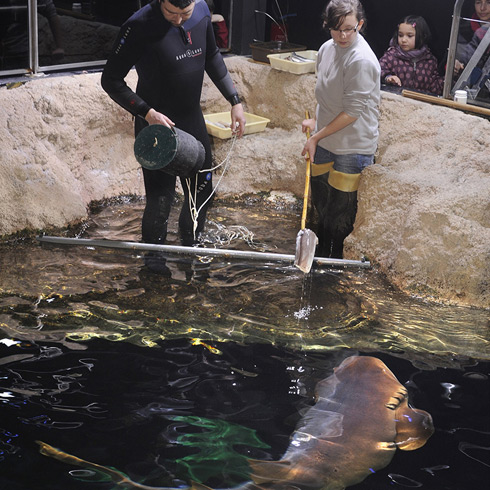
For the tunnel, it is a diver who is given the delicate task of feeding the fish, one by one, by hand.
A few special cases:
The octopuses and cuttlefish are fed daily with crabs. These animals actually have a beak in their mouth, which they use to shell the crab so they only eat its meat. Once they have had their fill, they spit out the empty carapace.
The Australian sharks are fed twice a week with pieces of fish (conger, whiting, mackerel …), cuttlefish or squid. The food is placed on the end of a stick, which is wielded from the surface in order to distribute the food evenly among the individual sharks. And yes, they only eat twice a week because their digestion is slow and a shark only eats 2% of its body weight in a week… so, an animal weighing a hundred kilos consumes only 2 kg of food! So, at the Océarium, although the sharks are the biggest animals, they actually eat the least! By contrast, the animals that eat the most are the penguins as they are fed three times a day with small oily fish (sardines, sprats and anchovies). Their food is given to them by hand but is also placed directly in their pool, where they like to race each other to catch as many fish as possible!